Cement company pledges to take its trucks off Copenhagen Street.
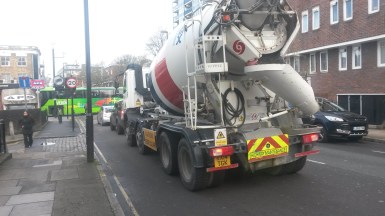
Cement mixers and other HGVs servicing Cemex plants have routinely been using Copenhagen Street
One of the largest cement companies operating in the Kings Cross area has instructed its drivers to comply with the HGV ban on Copenhagen Street.
This follows complaints to Cemex that its drivers routinely use Copenhagen Street as a route for HGVs heading towards construction sites east of the Angel.
Copenhagen Street, which has 3 schools on it, is a convenient short cut for trucks heading to and from the Cemex plants off York Way.
In response, Cemex managers have agreed to instruct their drivers to stop using Copenhagen Street and have specifically promised:
- All drivers from their two plants have been instructed not to use this route and required to sign a printed copy of the email to indicate their acknowledgement.
- The company’s Operations Supervisor has visited both plants and personally instructed drivers;
- All delivery dockets will bear the instruction not to use Copenhagen Street
- All the vehicles are GPS tracked so any driver using Copenhagen Street “will be disciplined” according to the company.
Cally Councillor Paul Convery says “Cemex is the first of the cement manufacturers to take action and I thank them. Copenhagen Street has had a 7.5 tonne lorry ban for many years but HGV drivers have increasingly been using it as a short cut. Next on the list is Hanson which also has a batching plant west of York Way and its drivers also use Copenhagen Street.”
“Getting a company to voluntarily abide by the lorry ban is a start. But our longer term goal is to have a physical width restriction that will prevent all HGVs from entering Copenhagen Street near to its York Way entrance.”
 Labour Councillors representing the Cally neighbourhood in Islington
The concrete trucks obviously shouldn’t be using Copenhagen Street, so this is good news in that respect. However, they are allowed to use Wharfdale Road. So, residents of this highly-polluted, narrow residential road will now have to tolerate an increase in concrete trucks – just as the 17 months of complete chaos caused by the Council implementing the ridiculous two-way scheme on Caledonian Road is hopefully coming to an end.
The Cally South group did, some time ago, request that the Council attempt to come to a voluntary agreement with Cemex that they would avoid Wharfdale Road. We were promised that Cemex would be approached. We are not aware of any progress being made regarding this matter.
Wharfdale Road is about the only road in the area that has not been resurfaced recently, despite the surface being in such a parlous state that residents are kept awake at night due to buildings shaking as vehicles bounce over the uneven road surface. We have asked for the road to be resurfaced. No progress here, either.
We have also had no luck in trying to get the dangerous pavements in the Wharfdale Road and the surrounding area repaired.
Surely planning consent was required for creation of batching plants (3), all located off York Way. Cemex is perhaps the one generating most HGV traffic as the other 2 have cement and aggregates delivered by rail, but ironically the Cemex plant (between Copenhagen and Gasworks Tunnels) has the space alongside that used to carry 2 railway tracks, and could have removed 150,000 Ton-miles PER DAY of spoil removal running for around 2 months with its footprint of pollution, road damage and crash risk created by just ONE project (Francis Crick on Midland Road).
The existing aggregate facility (St Pancras route) might offer the option to move materials in and out by rail, in loads of up to 1500T per train.
The canal can move loads of around 100 Tons (5 truck-loads) per barge, ideally loaded West of Camden as there are no locks all the way out to Ealing and beyond. Going the opposite way, traffic may be limited by water capacity and time for locking down although demand for increased capacity might justify the building of inclined planes to take boats up and down, using much less water. It is vital to preserve freight access to the canal, and residential developments must be very carefully managed to maintain that access.