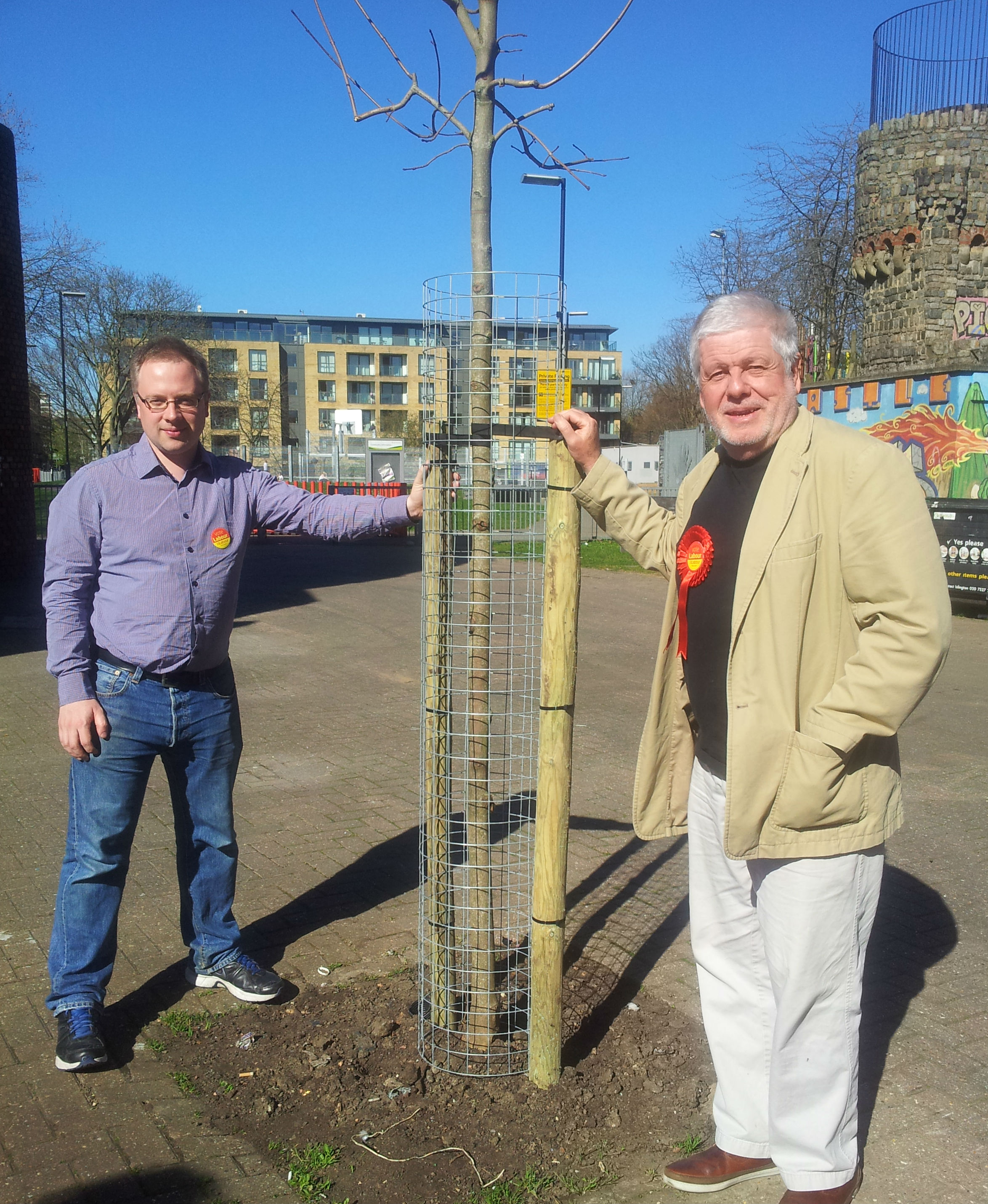
Rupert Perry (right) with Council Leader, Richard Watts, outside Bingfield Park. The freshly planted Maple sapling is in a tree pit left empty for over 10 years.
This spring, Islington Council has planted 47 new trees along Caledonian Road and adjoining streets. That’s more trees planted this season than at any time in the past 30 years.
Some of the new trees have been planted in the empty tree pits where damaged or dying trees had been removed over the previous decade but had not been replaced. In the Cally, a significant number of trees get fatally damaged by vehicles, particularly high-sided vans and trucks. Every tree which has had to be taken out in the past 4 years has now been re-planted.
Three quarters of the new trees have been planted in completely new sites – stretches of pavement where local Councillors have argued for new planting. Many of these sites have required careful selection for suitability because electricity, water, gas and other utilities run nearby. But they now bring street trees to stretches of pavement that were previously devoid of any greenery.
When Labour regained control of the Council in 2010, the new leadership promised to make sure that areas like Cally got a better share of Islington Council’s investment in highways improvements and environmental upgrade.
Cllr Paul Convery says “during the years when the Lib Dems controlled the Town Hall, all the Borough’s ‘streetscene’ investment seemed to go the already ‘leafy’ bits of Islington and nothing got spent in neighbourhoods like ours.
“Over the past two years, the Council has adopted the ‘Cally Plan’ which will bring better design standards, less street clutter, investment in pavement upgrades and environmental improvements. We’ve used the Cally Plan to fight for extra cash for trees in the neighbourhood. It’s taken a while and we’ve still got a long way to go but these new trees are already making a big difference adding much needed greenery to our streets”.
Click here to see a list of all the sites and the types of tree planted. The main species that have been chosen are: Acer usually known as Maple, the Sorbus family or Rowan (Mountain Ash), Betula or Silver Birch, Laurus nobilis which is a Bay Laurel and Tilia platyphyllos usually known as Large-leaved Lime or Linden tree.
Veteran and community leader, Bill Millett, has died aged 95
Former Royal Navy man and lifelong servant of his community, Bill Millet passed away on Good Friday.
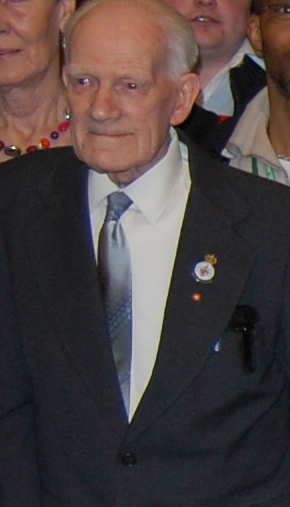
Bill pictured after receiving the Civic Award award from the Mayor of Islington, Cllr Phil Kelly
The son of an engineer, he was born in Ecclesbourne Road in Canonbury in 1918 and left school at 14 to work in Chapel Market. He got the call-up and decided to join the navy to see the world.
Bill served in the navy throughout World War 2 firstly aboard a warship that helped rescue British soldiers from the Dunkirk beaches and later saw action protecting merchant convoys.
In 1942, his ship, the cruiser HMS Arethusa, was torpedoed by Italian aircraft escorting a Mediterranean convoy. When the ship was hit, Bill was in the engine room. He escaped with his life although about a third of the crew did not.
Bill was one of the founding members of the Islington Veterans Association and turned out with colours for every ceremony on Remembrance Day and Armed Forces Day. He was awarded the MBE in 2003 for his charity work.
After serving in the navy he spent his career working for Metropolitan Water Board.
In 1974, Bill was the first person to get his keys and move into the newly built Westbourne Estate. He lived the rest of his life with his wife, Edith who died two years ago, on Mackenzie Road.
After he retired, Bill worked tirelessly as Chair of the Westbourne Tenants and Residents Association for many years, as well as chairing the Housing Panel, the Safer Neighbourhood Panel and was chair of the Westbourne Community Centre Board.

Bill alongside his comrades and previous Council Leader, Catherine West, outside the Town Hall at the first Armed Forces Day ceremony
As chair of the Safer Neighbourhood Panel, Bill took his role very seriously, and would patrol the Westbourne at 1am with a torch, making sure the estate was safe.
Cllr Charlynne Pullen said “I met Bill first at the Westbourne Community Centre because he organised my surgery. At our councillor induction, someone mentioned ‘council protection’ could come and help with our surgeries. That was not needed because, every month, Bill would set out the sign, arrange the forms, shepherd people in to see me, and work as the protection at my surgery. Bill was a fine man and an inspiring example of public and community service, a true Westbourne legend. We were proud to have known him”.
In March 2012, Cally Councillors successfully nominated Bill for one of the Mayor’s civic awards at a Town Hall ceremony.
Anti-social behaviour by a minority of boat owners is causing misery on the Cally section of Regent’s canal
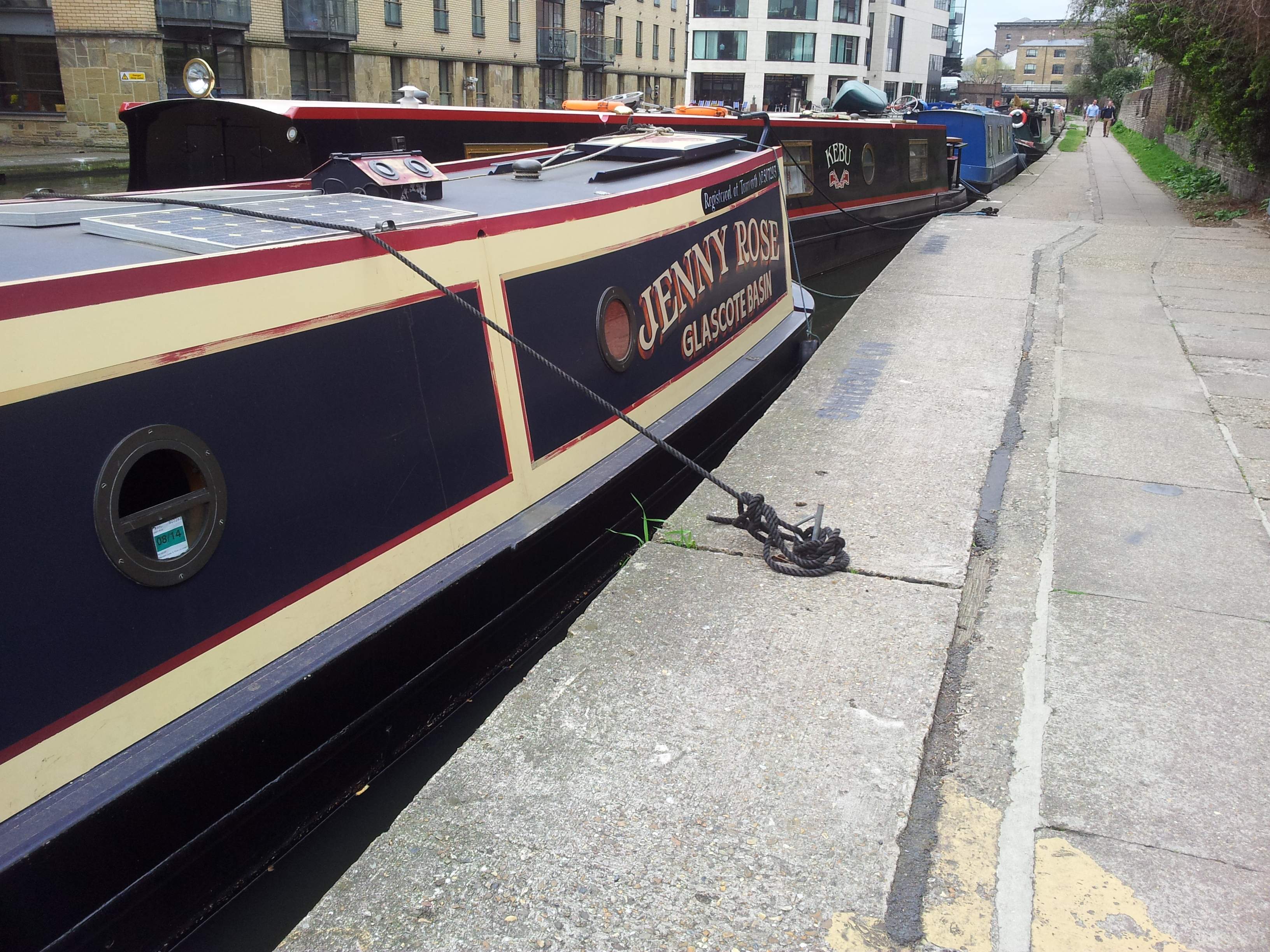
Double and triple parked boats along the entire length of the canal … often moored for months at a time
An unusual and serious form of anti-social behaviour is blighting the neighbourhood adjoining the Regent’s Canal between the canal bridges at Caledonian Road and Maiden Lane (York Way). It is caused by the behaviour of a small number of people who have begun to moor boats semi-permanently on the canal, contrary to the rules of the Canal and River Trust and in breach of environmental protection laws.
Some of the current group of people who are semi-permanently moored on this sensitive section of canal, run engines, generators, burn smoky fuel, play music, dump rubbish on the towpath and put effluent into the water. In late March, a mature plane tree on the towpath came down and some boaters have been cutting it up to burn the wood in their stoves.
Smoke from wood-burning stoves is polluting the many homes alongside the canal – including the Council and Housing Association estates at Tiber Gardens, Treaty Street and York Way Court – and the playground and classrooms at Copenhagen Primary School.
In response, Islington Council is working-up a series of enforcement measures against people causing noise nuisance and, most significantly, creating pollution by static diesel engines, generators or burning smoke-producing wood. Formal warnings have been given to some boaters requiring them to cut down noise especially from generators and static engibnes after 8pm.
The Council is also very firmly demanding that the Canal and River Trust (formerly British Waterways) must enforce mooring rules which are a condition of each boat’s license.
Paul Convery says “The people living on the boats have little regard for the places they have moored alongside. There is a group of anti-social boat-dwellers who believe they can pursue alternative lifestyles without any regard for the impact their presence has on residents by creating noise and smoke nuisance.”
Rupert Perry adds “The canal is a pretty big space so there is no need for boat owners to moor adjacent to peoples’ homes if that causes a problem. Most moorings are for a temporary period and permanent moorings require planning permission. The planning process enables issues such as proximity to houses, noise, pollution and impact on short term moorings etc to be considered.”
Cally Councillors do not say that all boaters should be removed from the canal. The main purpose for the Canal and River Trust in maintaining the country’s canals is to provide navigable waters for cruising boats.
But we do want stretches of the canal kept clear of moorings so that other canal users can carry on doing the enjoyable things historically we have done for years: fishing, feeding the ducks or just enjoying proximity to the water. It is one of the Trust’s principal objects that it maintains the canals for (a) towpath walking and (b) “recreation or other leisure-time pursuits of the public in the interest of their health and social welfare”. Endless lines of moored boats mean that is denied to thousands of towpath users.
On stretches where mooring is reasonable, we want the rules to be respected and the towpath used short-term by people who are cruising the canal for recreation. And we want these short-stay boats to comply with the 1993 Clean Air Act and the 1995 Environment Act by not making noise or fumes from burning, static engines or portable generators. In return we believe, that CRT should provide proper facilities for those visiting boats, such as fresh water, mains electricity and regular refuse collection along the towpath.
For reference, there are two main types of moorings on Britain’s canals:
- Short term: either “casual moorings” where boats may tie-up for 14 days (unless otherwise indicated); and “visitor moorings” which are places designated for shorter periods only, e.g. Islington Visitor Moorings at Noel Road where the maximum permitted stay is 7 days with a £25 per day charge thereafter.
- Long term: these are often called “home moorings” and specified in a boat’s license where a boat is kept when not used for cruising. These will be authorised residential moorings, leisure moorings or other commercial moorings (all of which must have planning permission).
Building new affordable Council homes on the Cally
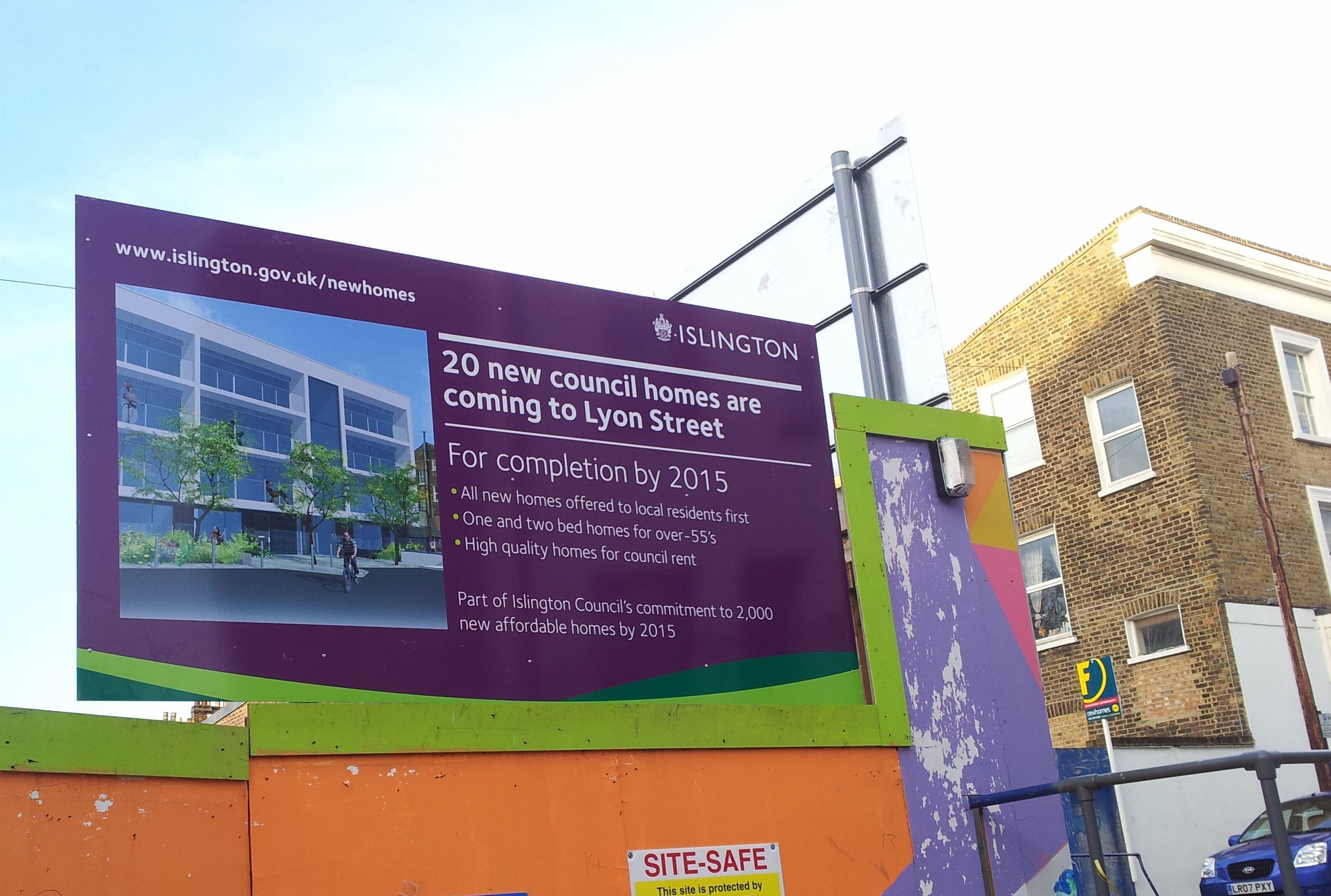
The new flats are being constructed to the highest energy-efficiency standards
The next 20 new homes for Islington Council tenants are being built just off Cally Road on the Lyon Street site, formerly the neighbourhood housing office.
The new homes will be mainly 2 bedroom flats in a development that is located on the corner of Lyon Street and Carnoustie Drive. Planning permission was granted in late 2012 and work began following demolition of the old housing office in 2013.
Every flat will be genuinely affordable and let at a “social rent” and the Council has also determined that these flats will not be subject to “right-to-buy”. This guarantees that they will always be available to tenants at properly affordable rents and will not slip into the hands of private landlords.
All the flats will be allocated to people aged over 55 with first preference given to tenants currently living on the Bemerton estate, particularly those in homes that are family sized. The aim is to help free-up larger homes that are now under-occupied by older single people or couples whose children are now grown-up and live elsewhere.
Islington Council’s top priority is to help several hundred families living in difficult overcrowded circumstances. By freeing-up some of the under-occupied homes, the Council can then re-house overcrowded families. The policy is also aimed at helping some people who are hit by the “bedroom tax”.
To keep new tenants’ energy bills down, the new homes will be built to the highest energy efficiency standards and the whole development is expected to be plugged-in to the Bemerton estate’s communal heating system.
Since May 2010, the Labour Council has directly provided more new homes than were built in the preceding 25 years. And despite Government funding nearly coming to a halt, the Council has helped Housing Associations to build on new sites and, using planning powers, has extracted affordable housing from numerous private developments.
In Caledonian Ward, where land is very scarce and extremely expensive, the Council has identified a number of sites already owned by the Council where new homes could be built. Last Summer a development of 17 new homes was opened at Vulcan Way after the Council converted a string of former garages into 15 ground floor flats and 2 new family sized houses. Both Vulcan Way and Lyon Street are examples of the new “local lettings” policy where tenants already living within the vicinity of a new development will be first in line for the new homes.
For more details, the Lyon Street planning report is available by clicking here.

New scaffolding and safety netting has been erected – demolition to begin soon?
For over 20 years, thousands of people travelling down Caledonian Road past its junction with Killick Street and Wharfdale Road will have wondered “why has that tumbledown building been left to rot?”
But, after legal threats by Islington Council, it now looks like the building’s owners are preparing to demolish and erect a “facsimile” building in its place. New scaffolding has gone-up and safety netting installed, prior to demolition.
Detailed planning permission was finalised in May 2013 for the demolition of the existing building and the erection of a 3 storey plus basement replacement with an “A1 use” (retail) at ground and basement floors and 3 self-contained flats (see below for fuller details).
The Council had been in contact with the owners repeatedly since their original planning permission was granted in 2011. Legal letters had been sent threatening formal action (which would lead to compulsory purchase) between June 2012 and June 2013. In October 2013, Islington Council received assurances from the owner that they will commence demolition in early 2014. They have promised a timetable with a new superstructure erected by August, roof installed in late October and the works completed by July 2015.
The Council is closely monitoring the site and progression of works and will consider further formal action if progress is not satisfactory.
Cllr Paul Convery comments “Many people, myself included, have been perplexed why this building has been derelict for two decades, especially considering the very high land values in the area. Partly the problem is “land-banking” where an owner just sits on a property waiting for its value to increase further. But it’s also due to a bit of ‘planner purism’ getting in the way, particularly from English Heritage. In a conservation area, it seems to be professional anathema for planners to have an old building torn down. Even if it’s almost collapsing through decades of abandonment. But now there is simply no economically feasible way the original fabric of the building can be retained. It’s just too far gone. After some pressure, our planning and conservation officials finally accepted that a demolition and re-build was the only possible way to rescue this site. I just hope the owners pull their finger out and genuinely get the redevelopment done. If they don’t – and we’re keeping a close eye on this – then the Council will re-commence legal proceedings”.
UPDATE: 12th February
Demolition work has begun but residents have asked if it is safe. The building is being demolished directly above the pavement. Cally Councillors asked the Council Streetworks team (who issued the scaffold licence) to revisit the site and they have now arranged modifications to be made to the scaffolding and agreed a revised demolition method for working alongside the highway (more dismantling than demolishing). The Streetworks team will continue to monitor the site to ensure public safety until demolition is complete.
Some more detail on the planning history: Permission was first given in 1986 but never used and the building became unoccupied. Almost twenty years later, in July 2005, permission was granted to “completely refurbish” with a shop at ground floor and five 1-bedroom flats including a mansard roof extension. This was never implemented. The owners put-up a 3 storey high wraparound advertisement hoarding without planning permission and the Council refused their retrospective application. Several further planning applications were submitted in order to demolish and rebuild but these were refused, most recently in 2008.
In May 2013, detailed permission was granted to new owners (P2012/0111/AOD) pursuant to planning application P112597 (an original permission grantedFebruary 2012) for the demolition of the existing building and the erection of a 3 storey plus basement facsimile building with a ground and basement A1 unit and 3 self contained flats (3 x 2 beds). The applicants are private developers, Mr and Mrs Schwarzemann who have a registered address in Edgeware and their architects are Design Solutions based in NW6. The Design and Access statement is here http://planning.islington.gov.uk/NorthgatePublicDocs/00172785.pdf with drawings of external detailing here http://planning.islington.gov.uk/NorthgatePublicDocs/00049742.pdf and internal plans here http://planning.islington.gov.uk/NorthgatePublicDocs/00049742.pdf
Fantastic new bakery shop opens-up on Cally Road

Paul O’Brien and Gabriela Cristea: “Baking with heart and soul”
“Sunflour bakery” has opened for business at 263 Caledonian Road, selling a fantastic range of fresh bread, cakes and pastries all hand-produced on the premises by the partnership of Paul O’Brien and Gabriela Cristea.
This great addition to the Cally high street has been trading since just before Christmas and is already delighting customers from both sides of the Caledonian Road.
Each morning Paul bakes a great range of tasty bread, brown, white, wholemeal with two signature loaves that are especially popular – a brown sunflower seed loaf and a traditional Irish Soda (or “Wheaten”) Bread. Gabriela produces wonderful sweets, cakes and pastries including a lovely cinammon flavoured bread pudding. They also bake made-to-order cakes for special occasions. And Gabriela also serves very good coffee !
Cllr Paul Convery says “What a great new business this is. Paul and Gabriela are producing very high quality bread made with the best ingredients and nothing uneccessary added. I always used to buy our bread from the Co-op but that’s no longer. Sunflour Bakery produces some of the best flavoured and textured bread I have ever tasted. To have a bakery of this quality on our high street is testament to how things are really improving on the Cally.”
The Sunflour bakery is at 263 Caledonian Road, N1 1EE. For easy reference that’s on the west side of Caledonian Road between Bingfield Street and Story Street (almost opposite the post office located between Bridgeman Road and Richmond Avenue). The shop is open Monday-Saturday until 6pm.
Labour announces Caledonian ward candidates for May 2014 elections
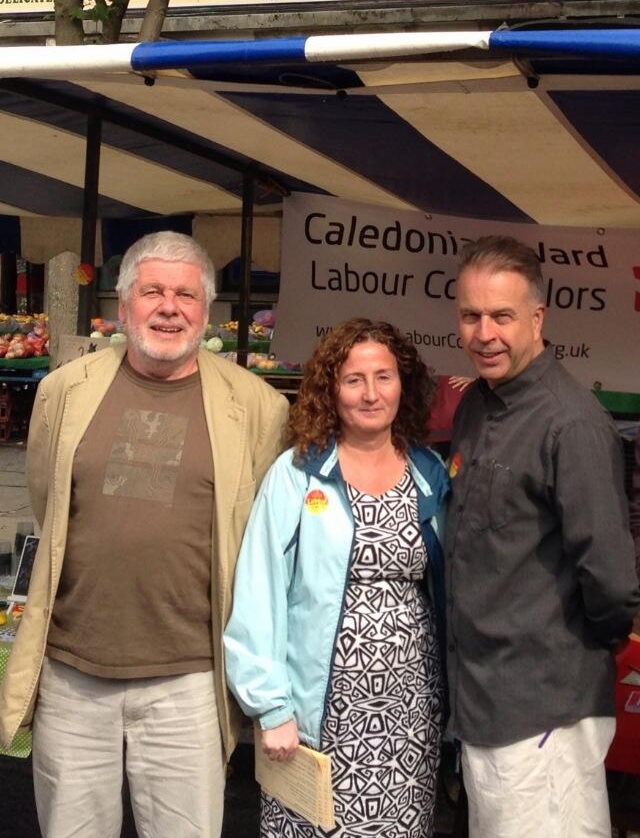
Rupert, Una and Paul pictured at the Cally Festival last September
Rupert Perry and Paul Convery will be re-standing in this year’s election for Islington Council and will be joined by a lifelong community campaigner, Una O’Halloran.
Rupert and Paul were both elected for Caledonian Ward in 2006 and re-elected in 2010. Previously Rupert had represented the Cally from 1990 to 2002. Both are well known in the area (Rupert especially) and need no introduction.
Rupert and Paul were delighted when the local Labour Party picked Una to fill the slot after our 3rd Councillor, Charlynne Pullen, decided against re-standing.
Una was born and raised in the south of Islington and has been actively involved in community affairs for more than 15 years. For the last 6 years she has been chair of her local tenants association, the Safer Neighbourhood Panel and local Housing Panel.
In her daytime job, Una is a Teaching Assistant in a local school where she is a GMB member and workplace representative. Una is actively involved in two local churches and is also a school governor.
Paul Convery says “We’ve got an outstanding candidate in Una. She is going to be a great Councillor working hard for the people on the Cally. Una has got her feet firmly planted on the ground. She modestly says she is an ordinary person who wants to work hard for people like herself.
“When Labour picked her she said very eloquently that she knew the benefit of education to combat poverty and, as an active member of her local churches, she ‘knows the value of faith and community’.
“I think Caledonian Ward is going to be an even better community having Una as its next new elected representative.”
Over the next 3 months, Charlynne Pullen will be fulfilling all her duties as a local Councillor right up to election day.
A £350,000 facelift for Cally Pool announced by Islington Council

Cally Pool is a much loved community facility … but in recent years it’s been getting a bit tatty
Islington Council has announced a £350,000 upgrade to the facilities at Cally Pool. The Council has successfully raised £250,000 in Lottery sports funding and is matching it with £100,000 of the Council’s own scarce capital funds. The work will start just before Christmas and is subject to consultation with users, especially the organised swimming clubs.
The investment will pay for new changing rooms, showers and other fitness facilities. The present Cally Pool suffers from very basic facilities and users have recently complained that the cleaning standards and general hygiene could be significantly improved.
Caledonian Ward Councillor, Paul Convery says ”My wife and I take our kids to lessons each week at Cally Pool and we all enjoy swimming there. The staff are good, friendly people who are very aware of the building’s limitations. However, the experience for swimmers is not that great especially compared with other Islington pools like Highbury or the fantastic renewed facility at Ironmonger Row. It is perfectly possible to provide a great standard of service even at a dilapidating facility although, in fairness, it is harder and possibly more expensive to do so. The Cally deserves better than this. That’s why Islington’s Labour Council has acted to improve our local pool.”
Islington Council is currently re-tendering the entire leisure contract and service quality will be one of the fundamental criteria in awarding that contract. But with the £350,000 investment in place, there is no reason why Cally Pool cannot match the standards achieved in other Islington pools.
Cllr Janet Burgess, the Council’s Executive Member for Health & Wellbeing added “Cally Pool is a much loved and well-used community facility, so we are delighted to announce £350k from Sport England and Islington Council to upgrade changing rooms, showers and other fitness facilities starting before Christmas. It has needed this upgrade for some time, and I am very pleased that we have now managed to get the funding in these difficult times.
“Older facilities can be harder to maintain and clean but that’s not an excuse and we are concerned if some users have had a poor experience lately, whether at the Cally or elsewhere. We hope our investment helps Cally Pool match the consistently high standards achieved in other Islington pools. I am sure that Cally Pool users will help us monitor this and I ask for their patience whilst the work is carried out.”
 Residents, traders and other well-wishers gathered at the weekend to mark the completion of the new logo on the old “Ferodo” bridge on Caledonian Road. The bridge is a local landmark that carries the North London freight line and Overground service over the road just west of the Caledonian Road & Barnsbury station.
Islington Council’s Deputy Mayor, Councillor Theresa Debono, officiated the unveilling and the release of balloons to celebrate the occasion.
The new slogan “The Cally” was chosen in a straw poll conducted by local Councillors in which the winning words were chosen by a large majority of participants.
The new logo represents a further step forward towards improving the look and reputation of the Cally Road. The unveilling of the new bridge scheme comes in the weeks running up to the 2013 Cally Festival on 8th September.
Councillor Rupert Perry says “We’re making a big effort to spruce-up the Cally Road and the new bridge logo is a very visible sign of change that’s coming. It’s important to get a good balance between the ‘old’ Cally and the ‘new’. The road itself is the High Street for our neighbourhood and, to some, it represents a boundary between the communities on the east and west sides of the road. We’re determined to create a distinctive, single place that is shared by everyone so that all our residents can say the Cally belongs to us all.”
The Council had learned in March this year that Network Rail intended to repair and repaint the bridge and remove the old Ferodo advert in the process. At that point, local Councillors through Team Cally, requested that Network Rail allow a new sign to be painted and this was agreed. The new words have been painted using a typeface that resembles the old Ferodo lettering. Apart from the relatively small cost involved in acquiring lettering stencils, the bridge has been repainted entirely at Network Rail’s cost.
Controversial Cally Road student housing nominated for “Carbuncle Cup” – one of Britain’s nastiest new buildings
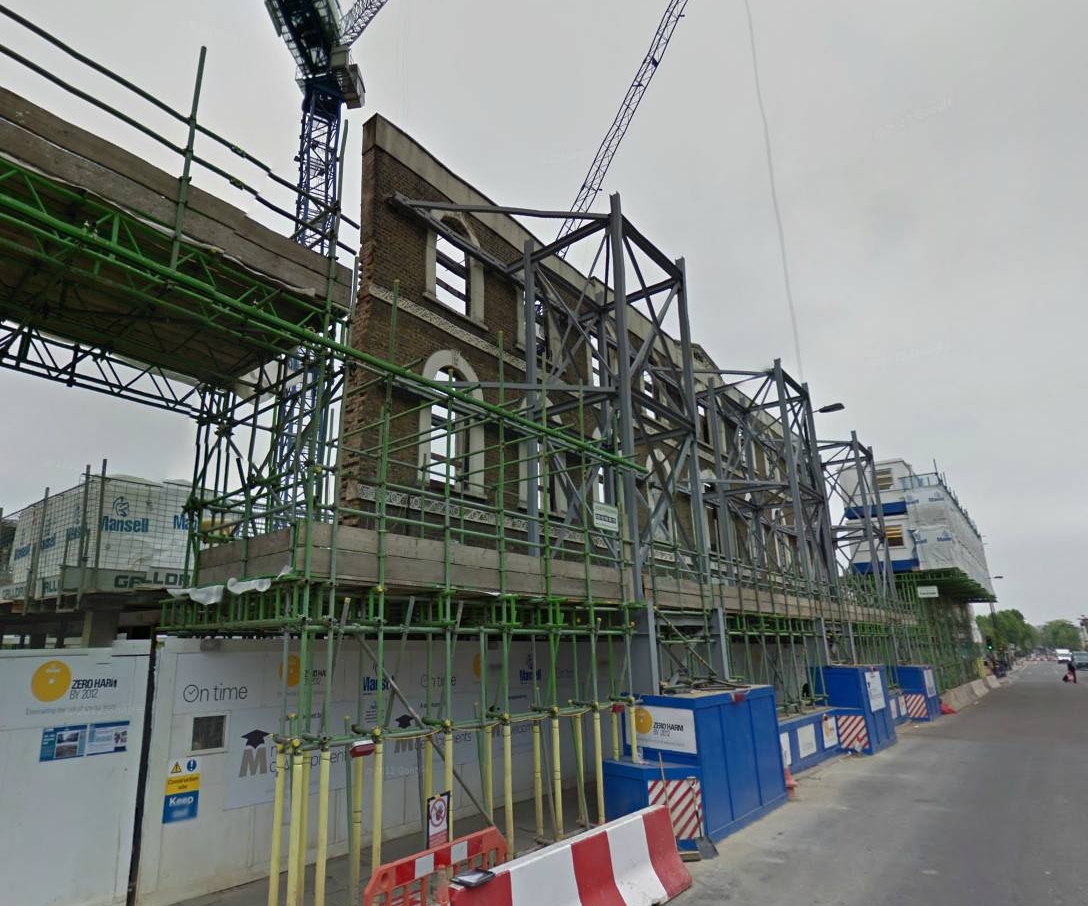
Picture shows the listed facade in May 2012. A completely new multi-storey building has now been erected about 4 feet behind the old masonry which stands propped-up on its own.
An £18 million 350 room student housing development on Caledonian Road has been nominated for the “Carbuncle Cup” – a prize for the country’s worst new building in an annual awards competition.
The building at 465 Caledonian Road was refused planning permission by Islington Council in April 2010 but the developer got this decision overturned by submitting an appeal to a Government appointed planning inspector.
In April 2010, the Council did not have any planning policy to limit the number of purpose-built student residences. This only happened after Labour took control of the Town Hall in May 2010. So the decision by the planning committee in April 2010 cited as reasons for refusal: “its bulk, mass and height were unacceptable; insufficient daylight would reach some rooms in the development.”
In a highly controversial decision, the Inspector ignored evidence that showed student rooms would not have the legal minimum of daylight. Instead he declared that “student lifestyle” meant the rooms would only be used for sleeping and therefore didn’t need the full quota of daylight.
The facade of the original warehouse in Caledonian Road, dating back to 1874, was locally listed and therefore had to be retained. It now sits a few feet in front of a new building. The floor levels and internal walls of the new building do not align with the original building. As a result, 23 of the 44 rooms facing the street look directly onto the masonry of the facade’s “back” wall. For those students, the street is only visible at an oblique angle.
Caledonian Ward Councillor Paul Convery was chair of the planning committee which refused permission in 2010 says “I was staggered when the Planning Inspector overturned our refusal decision. His amazing disregard for normal daylight and design standards was quite extraordinary. Now the building has emerged from its hoardings, the full absurdity of the design is suddenly apparent. If it weren’t so bad it would be laughable. This building is a complete joke.”
This case dramatically strengthens the argument that developers should not be allowed to routinely appeal againt local planning decisions. Paul Convery adds “too often, when developers fail to get a planning permission they just automatically lodge an appeal in the hope that they can get a different decision. They hire top lawyers and planning consultants to bamboozle Planning Inspectors. And by racking up huge legal fees, they threaten the local authority with a “costs judgement” meaning that, if the Council loses an appeal, it may have to pay the developer’s legal bills too. In some cases, the risk of costs means a local authority backs down. I’m glad to say that, in Islington, we don’t let developers bully us like that.”
Islington Councillors are calling for the law to be changed so that developers can only submit an appeal where they can show legitimate reasonss, for example, if the local authority has disregarded its own policies or failed to take significant evidence into account. This would bring planning appeals into line with the rules on appeal in the civil and criminal legal system.
The Inspector’s decision letter is available here. It is worth reading for the sheer audacity with which the developers and University College London told the Inspector that daylight didn’t matter to students because they “only sleep there”. The Islington Tribune also carries the story here.

