Saying no to another betting shop on Caledonian Road
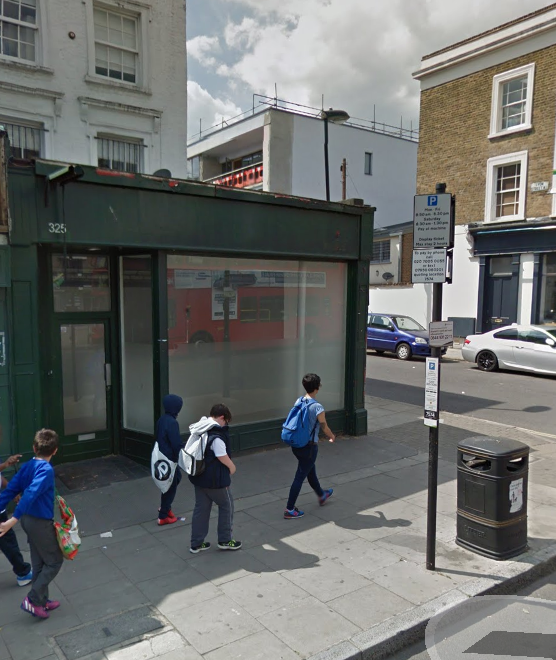
The offices of Harters solicitors closed down suddenly in January 2013. Now Paddy Power wants to open up there.
Caledonian Ward councillors have opposed plans by the Paddy Power gambling company to open another betting shop on Caledonian Road. The premises at 325 Caledonian Road are currently a vacant shop/office on the corner of Lyon Street which is a short cul-de-sac.
To open a new betting shop, Paddy Power has to get two separate permissions from Islington Council: a license and a planning consent.
Cally Councillors have opposed the license application saying it contravenes the Council’s gambling policy:
- the high street already experiences high levels of crime and anti-social behaviour including a specific problem of on-street drinking and another gambling shop will exacerbate these problems.
- the premises are located in a small area containing 5 primary schools and a Children’s Centre
- with two other betting shops in close proximity, this would mean a significant concentration of gambling premises contrary to the Council’s “saturation” policy.
The Paddy Power company does not have a planning consent for the premises. Applications have been submitted for change of use, alterations to the building and for illuminated sign. Cally Councillors will be opposing these applications too.
Councillor Paul Convery adds “Gambling companies are cynically pinpointing areas like the Cally – and other neighbourhoods in Islington where we have the poorest households – to open up betting shops. There’s nothing wrong with putting a few bob on a horse every now and then but these betting shops have aggressive business plans which encourage gambling – especially the use of fixed odds betting terminals which are sophisticated ‘one-arm bandits’ described as the ‘crack cocaine’ of gambling. With two other bookies on the high street, this is one kind of shop the Cally doesn’t need.”
The Cally Festival on Sunday 14th June will celebrate a proud community pulling together
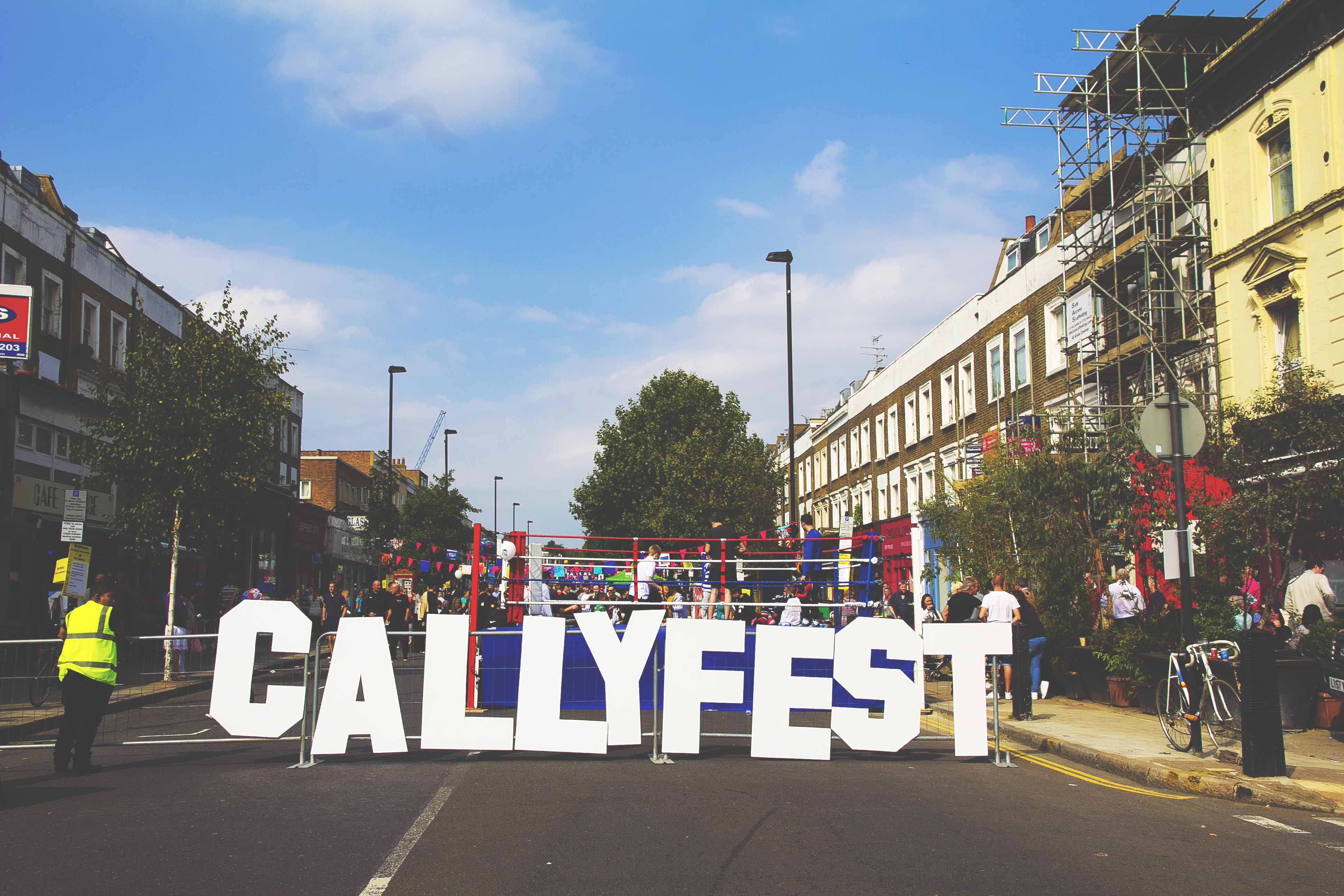 This Sunday, 14th June, is the Cally’s 5th annual festival. It’s the pinnacle event to an all-year-around programme of improvement to our neighbourhood and high street that aims to bridge the gap between the many communities in Cally.
The Festival shows that we really are a community that’s pulling together.
On Sunday, the entire main road between Cally Bridge and Cally Pool will be closed and filled with a street market, dancing, story-telling, a kids zone, street theatre, arts & crafts, food & drink plus, of course, lots of live music. And about 8,000 people.
Click here to download the official festival programme which shows 2015 is going to be the most ambitious ever.
The weather forecast is looking good for Sunday too: dry, light cloud and sunshine with the temperature reaching about 18 degrees by lunchtime.
It all kicks off at noon. There will be a short (very short) “civic” moment at around 4.15pm at the main stage when the Mayor will appear along with MP, Councillors and Leader of the Council.
Local Councillors, Rupert Perry, Una O’Halloran and Paul Convery, look forward to seeing you on Sunday. We’ll be “circulating” or find us at the Cally Labour Councillors stall.
For more information and daily/hourly updates on Facebook go to www.facebook.com/TheCallyFestival or on Twitter go to @The CallyFestival

Static traffic backed-up at the lights on Wharfdale Road (picture https://twitter.com/neighbour_kx)
The Caledonian Road two-way traffic scheme is not working as planned and, in its current form, has caused inconvenience and distress. At a public meeting on Monday 8th June, local Councillor, Paul Convery, apologised to those affected and promised that flaws in the scheme would be fixed.
Cllr Convery assured the 50 local residents at the meeting that the number of vehicles on Wharfdale Road has not increased as a result of the scheme. However the flow of traffic is irregular because the phasing of traffic lights at the corner of Wharfdale Road and Caledonian Road does not allow sufficient time for traffic to move from Wharfdale Road into Caledonian Road.
He admitted that the traffic signals are not properly phased but was confident this would be fixed within a fortnight. Although the re-phasing had been promised in March, a technical problem with the system has prevented the “traffic optimisation” electronics from working properly.
Convery reiterated that the Council had introduced the scheme for good reasons and this had been supported by a four to one majority in a public consultation. The new layout was intended to:
- reduce the congestion and queuing that had affected the lower parts of Caledonian Road;
- achieve a traffic calming effect on the lower parts of Caledonian Road, especially high speed driving
- improve the pedestrian environment around the Killick Street junction;
- create a safe cycle route from Wharfdale Road into Killick Street (south) and towards Pentonville Road
Although the incorrect phasing of the signals is the main problem causing queues, Cllr Convery has proposed further measures to protect residents from excessive standing traffic:
- Close-off entry from Killick Street (south) into Caledonian Road
- Impose HGV restrictions on Wharfdale Road
- Change the lights phasing at the junction of Wharfdale Road and York Way and introduce a “straight-across” pedestrian crossing
- Retaining no-right turn from Goods Way into York Way southbound
- Reviewing the parking conditions on Caledonian Road bus lane
Fuller details of the proposals are listed in a statement produced for Monday’s meeting.Cllr Convery also apologised on behalf of the Council saying: “I am very sorry that we were unable to implement the correct phasing of the lights from the very start. I hope that the proposed measures will return traffic flow to previously experienced patterns and that, over the longer term, we can fundamentally reduce the amount of traffic on Wharfdale Road and the surrounding streets which make up the north section of the Kings Cross gyratory.”
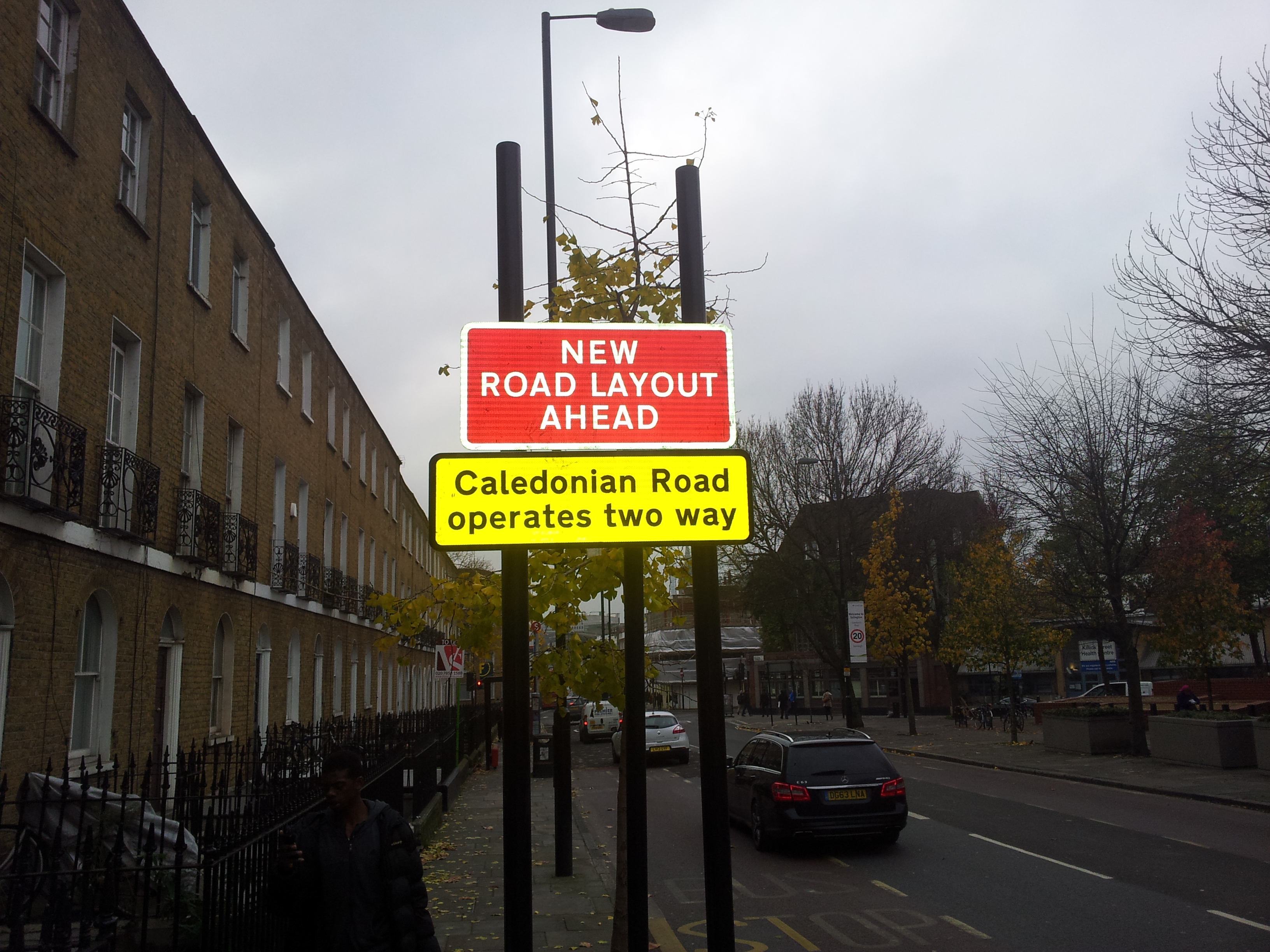
The new traffic flow began on 27th November.
Islington Council has taken the first steps towards removing the hated Kings Cross gyratory system by returning the Caledonian Road to 2-way traffic. The section of road between Wharfdale Road and Caledonian Street has been re-engineered to remove the 1-way system. It was opened to new patterns of traffic earlier this week.
The changes to the road layout were subject to a public consultation exercise which showed widespread support. The aim of the new road layout is to reduce traffic speeds by introducing a contraflow to what previously had been called a “three lane, one way speedtrack”.
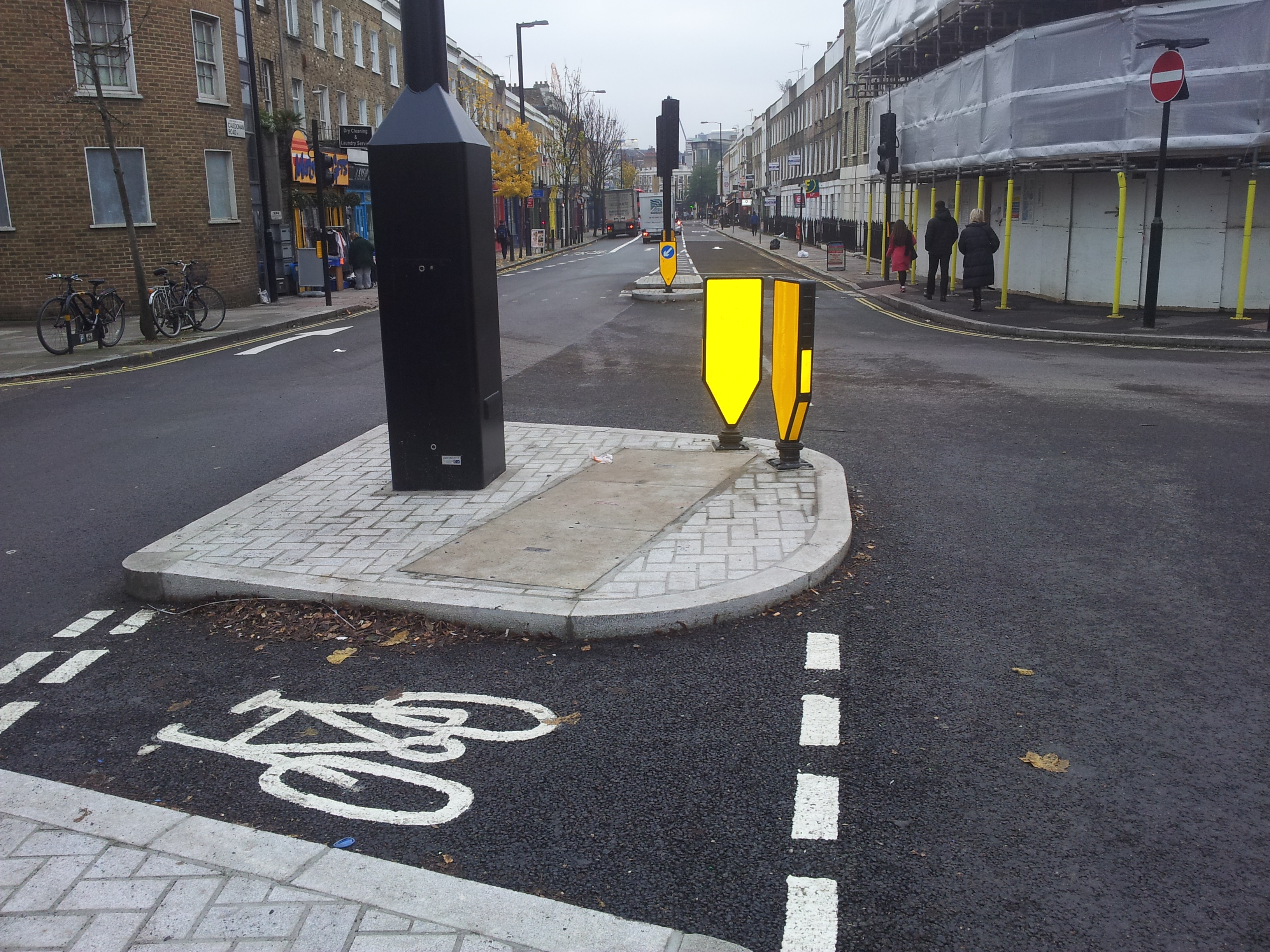
A new cycle route has been built into the Wharfdale Road – Killick Street junction.
A cycle priority phase has been programmed into the signals plus a specially engineered route through the Wharfdale Road junction junction constructed for cyclists.
The complicated junction of Caledonian Road with Wharfdale Road and Killick Street has been rebuilt to include an additional lights-controlled pedestrian crossing. A cycle priority phase has been programmed into the signals plus a specially engineered route through the Wharfdale Road junction constructed for cyclists.
By creating a through route for cyclists across Caledonian Road from Wharfdale Road to Killick Street this represents an initial phase in the construction of alternative routes for cyclists who wish to bypass the most congested and risky parts of the Kings Cross road system.
Residents have expressed concerns that drivers and pedestrians may be confused by the new road layout. Numerous warning signs have been positioned to alert road users about the new configuration.
Cllr Paul Convery comments “everyone living and working around Kings Cross knows that the road system and its thunderous heavy traffic blights the area. It’s a relic of the 1960s and 1970s mentality when London’s decision-takers decided to carve the most environmentally unfriendly gyratory systems out of a neighbourhood they probably thought didn’t matter.
“Today Kings Cross does matter. It’s Europe’s busiest public transport interchange and it’s becoming an important business centre and cultural hub alongside a large residential population. The removal of the Caledonian Road one-way section is the first step to removing all the gyratory roads around Kings Cross. Most of the system is controlled by Transport for London under the direction of Mayor Johnson. But Caledonian Road is an Islington Borough Road not a TfL one. So whilst TfL threatens years of delay before it removes the gyratories, in Islington we’ve decided to take the bold step of removing the one section of the gyratory that we control. We hope TfL takes notice.”

Tesco is not a “good neighbour”. Here’s how they routinely store stock trolleys on the street at the Kings Cross branch
Cally Councillors have opposed an alcohol license application made by Tesco for premises at 323-325 Caledonian Road. The retail giant wants to combine two shops on the corner of Lyon Street and Caledonian Road. This would be its third store on Caledonian Road – it already has an outlet at Caledonia Street near Kings Cross and another one opposite the Caledonian Road underground station. The latter is only 350 metres (or 2 bus stops) distance from the corner of Lyon Street.
In its application, Tesco wants to supply alcohol for 15 hours a day 7 days per week trading between 8am and 11pm. However, the company wants to open-up in an area which the Council’s licensing policy has designated as an “area of cumulative impact” more commonly known as a “saturation zone”. The licensing policy says that, in such an area, there is “a rebuttable presumption” that a license application “will normally be refused” and the applicant must demonstrate how a new license “will not add to the cumulative impact”.
The Tesco application makes no mention of the saturation zone or how they might ensure such a new license does not worsen the existing level of excess alcohol retail. It does not even mention the cumulative impact area.
In its preparations to convert the two premises (one of which was previously a solicitors office) Tesco has already tried to get parking restrictions changed so the company can unload deliveries on the main road. Islington Council has refused to permit this.
Cally Councillors have also challenged the license application because Tesco does not have necessary planning permissions to combine the two premises. In some cases, planning legislation would allow the conversion of a solicitors office into retail use under “permitted development rights” but only if the premises had a display window at ground level. Number 325 has never had such a display window.
Islington also has a policy to oppose the amalgamation of conventionally sized shops into larger units. And the recently adopted “Cally Plan” adds special local weight to this policy.
The operating hours of the previous solicitors office were normal business hours. Tesco wants to trade until at least 11pm every evening 7 days per week. So the company needs a planning permission to operate such hours. It does not have such a planning permission.
Local residents and existing retailers on the Cally Road have expressed their opposition to a Tesco opening-up in this area and have opposed the granting of an alcohol license. Anyone wishing to object to the license can do so by emailing licensing@islington.gov.uk for the attention of John Williams and quoting the reference address 323-325 Caledonian Road.
Cllr Paul Convery comments: “Our high street could do with new investment but Tesco is the kind of store that may put many existing traders out of business. We already have two chain multiple retailers, Co-op and Iceland, catering to a wide range of retail needs and the arrival of Britain’s biggest and most aggressive retailer will not be good. Tesco has a reputation for driving out existing shops and its arrival – along with an 8am to 11pm alcohol license – will damage the Cally. What we really need is great independent retailers with their feet and hearts in our community. Tesco brings sterility and anonymity to the places its shops open-up in.”
The Tesco application can be read by clicking here.An official letter from the Council inviting residents to respond is available here. A copy of Islington’s current Licensing Policy can be read by clicking here.
The 4th annual Cally Festival: another fantastic day
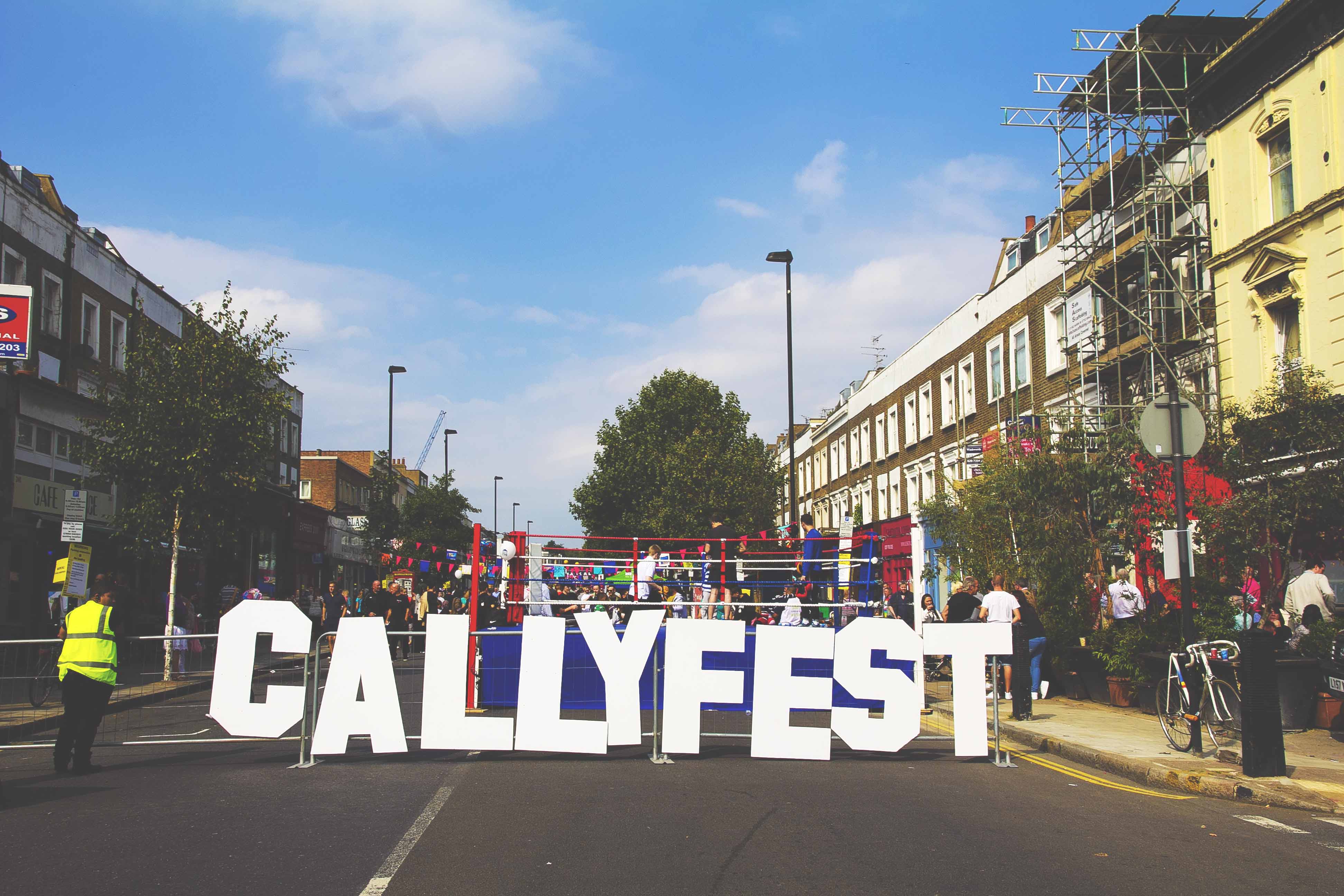
You couldn’t exactly miss this! The road was closed all the way from Cally Bridge to Cally Pool
The Cally Festival on Sunday 7th September turned out to be the best ever. That was the verdict of many of the 8,500 or so people who attended the 2014 annual festival.
Sunny weather gave an already outstanding event that extra sparkle. In addition to a street market of over 50 stalls with food drink, arts, crafts, books from local businesses, there were stalls featuring two dozen local groups and organisations.
Three music performance stages, a street disco, story tellers’ stage provided fantastic entertainment. This year the Festival included:
- Story Street: poet Paul Lyalls presents an off-the-wall afternoon of poetry and stories on Story Street including Andrew Bailey, A.F. Harrold, Joshua Seigal, and Roald Dahl Museum storytellers.
- An “Action Area” with sports and activities from Times ABC Boxing Club, Arsenal in the Community and the Cally Pool.
- Pirates Adventure: Crumble’s Castle Adventure Playground presented pirate themed play from sword making to bandana decorating.
- The Arty Block Party: organised by Peabody, local artists created a ‘block party’ like no other. A whole street dedicated to arts workshops.
- Bus Stop Dance Floor: dancing in the street all day long with 70s disco favourites, salsa, Charleston, a Tea Dance and a Hula-hoop-off.
- The Keskidee: the story of the Britain’s first arts centre for the black community, the Keskidee Centre. Featured music, dub-poetry and theatre, with a special performance from master kora player Tunde Jegede.
- Youth Stage: young people from the Copenhagen Youth Project and Uperform with line-up of music, dance, rap, poetry and DJing.
Finally, the main stage presented some of the great music and performance the Cally has to offer. The bill-topping attraction was local band “Burning Wheel” and featured a guest appearance by local celebrity “Dave Elvis”. Dave closed the show and thrilled the crowd with a 6pm encore of Blue Suede Shoes.
Here some of the very positive comments we’ve seen.
- “It was truly an amazing event on Sunday. I have picked up so many positive vibes. Everyone spoke of a community spirit that they had not felt for a long time. Over the last two day I have had nothing but positive feedback.”
- “The one word for me summing up the day was ‘authentic’. I know that’s an overused word but today it really applied”
- “It’s a tremendous symbol of how far the area has come. And it’s a real Festival – not just the usual rent-a-stall-street-thing but has a strong vein of genuinely local groups celebrating their stuff and eclectic artists and performers.”
Siobhán Dennehy who lives on the Bemerton Estate ran a stall where she asked festival goers “Why do you like the Cally”? Click here to read the fantastic range of answers she got.
Cllr Paul Convery added: “this was another outstanding event that shows Cally is a place that’s pulling together. A great day resulted from immense hard work by local people, artists, businesses, community groups, organisations and, of course, Islington Council. The Festival is a pinnacle event to an all-year-around programme of improvement to our high street that aims to bring together the many different people of the Cally. It shows that we really are a community that’s pulling together to make the Cally a place we are proud of.”
Click on the thumbnail images in the gallery below to view a selection of pictures from the day.
Don’t miss the Cally Festival, Sunday 7th September
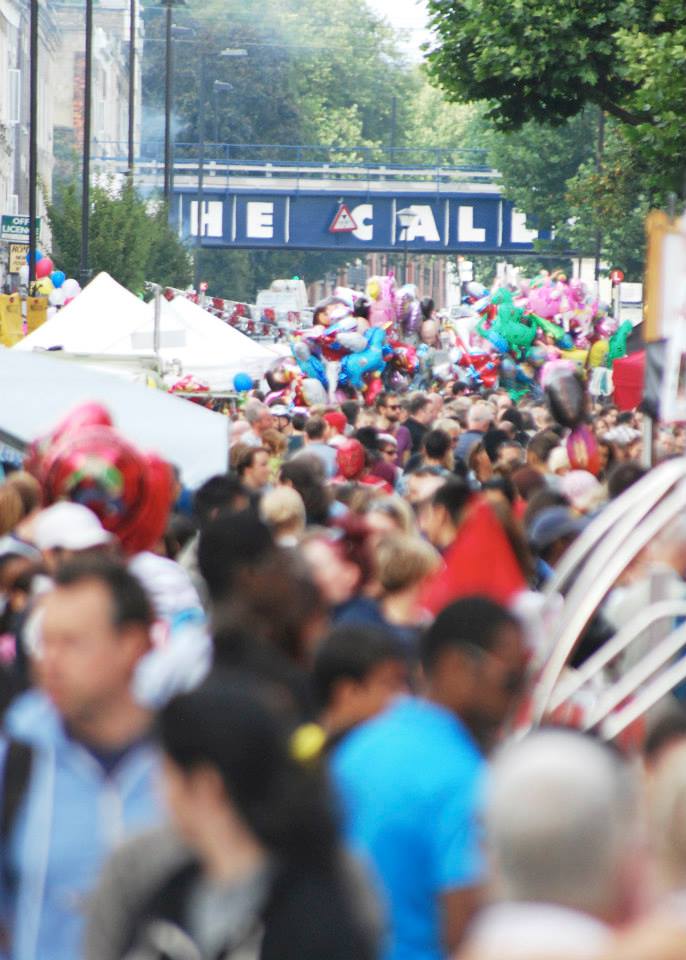
Over 8,000 people attended last year’s Cally Festival
This Sunday, 7th September, is the Cally’s 4th annual festival. It’s the pinnacle event to an all-year-around programme of improvement to our high street that aims to bridge the gap between the many communities in Cally.
The Festival shows that we really are a community that’s pulling together.
We close the entire main road between Cally Bridge and Cally Pool and fill it with people, stalls, kids’ stuff, live music, activities and, this year, it will have a strong visual and performing arts theme.
Click here to download the official festival programme which shows 2014 is going to be the most ambitious ever. The weather is looking good for Sunday … light cloud, sunshine and temperature around 22 degrees. Perfect.
It all kicks off at noon.There will be a short (very short) “civic” moment at around 3.45pm at the main stage when the Mayor will appear along with MP, Councillors and Leader of the Council.
Local Councillors, Rupert Perry, Una O’Halloran and Paul Convery, look forward to seeing you on Sunday. We’ll be “circulating” or find us at the Cally Labour Party stall.
For more information and daily/hourly updates on Facebook go to www.facebook.com/TheCallyFestival or on Twitter go to @The CallyFestival

A for-sale-by-auction sign went up on the building on June 30th.
A dormant charity is trying to cash-in by selling a Cally community building. For over 4 years, Councillors and local campaigners have been trying to bring this building back into use. Now, Councillors and outraged local residents are trying to block the sale. In 2010 Cally Councillors pledged to try and rescue the building from disrepair and disuse.
The charity which controls the building is called the ‘Underdog Trust’ and is effectively a one-man outfit. It has provided no services of any kind to the local community for decades. Run by a Mr Marg McNeil, the charity has clearly been in breach of its charitable objectives for many years.
Despite this, the Charity Commission has failed to step-in and Islington Council has, instead, acted to exert influence over the building’s future and use.
Islington Council had already started to charge full business rates on the building having revoked a 80% concession on business rates that is available to all legitimate charities. When Mr McNeil challenged this in court, Islington Council won. The judge ruled that the charity did not qualify for the discount on its business rates which a genuinely active charity would automatically qualify for.
Cllr Paul Convery comments “It’s bad enough having a rogue landlord on the Cally. Now we have a rogue charity. Selling this building is a scandal.
“The Underdog charity has been dormant for a very long time and has sat on a valuable asset for years. It has rejected demands by local councillors to publicly account for what it does. That’s because it does nothing.
“The charity has been used by one person exclusively to pursue a hobby which is of no use to anyone and is in clear breach of the Trust’s charitable objectives. Now that man wants to sell the building. If successful, the money from the sale will go into this dubious charity’s bank accounts and the asset will be taken away from this neighbourhood. We shall pursue every available route to prevent this happening.
“The building is up for sale by auction on July 17th and we shall warn the auctioneers that Underdog Trust may not have “clear title” to sell; that the particulars of sale misrepresent the building’s permitted use; that the Council has a legal charge against the building; and that a valid permission must be given by the Charity Commission prior to its sale.
“To sell it under these circumstances could be fraudulent.”
Details of the attempted sale can be viewed here. The charity’s entry on the Charity Commission register can be viewed here.
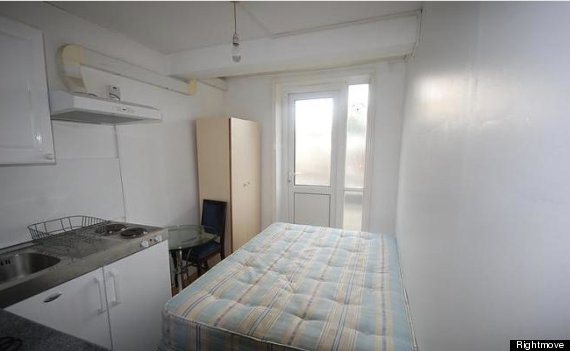
This tiny “studio” flat at Kember Street, advertised online by estate agent, prompted Islington Council to immediately investigate.
The case of a tiny flat offered for rent will finally “nail” a landlord who has previously “wriggled off the hook” of enforcement, say Cally Labour Councillors.
Notorious landlord, Andrew Panayi, has hit the headlines after trying to rent one of the smallest bedsitter flats ever seen in London. City-wide and national news organisations seized on the story of a tiny bedsit letting at 1 Kember Street on the Cally Road for £737 per month. The reports appeared in the Independent, the Standard, the Guardian and in the local papers.
On Twitter and Facebook, the story went viral (as they say) with comments like “this picture says it all about London’s crazy housing situation”.
But to Islington residents, this was another chapter in the continuing battle against a landlord who has turned the Cally neighbourhood into a byword for racketeer landlordism.
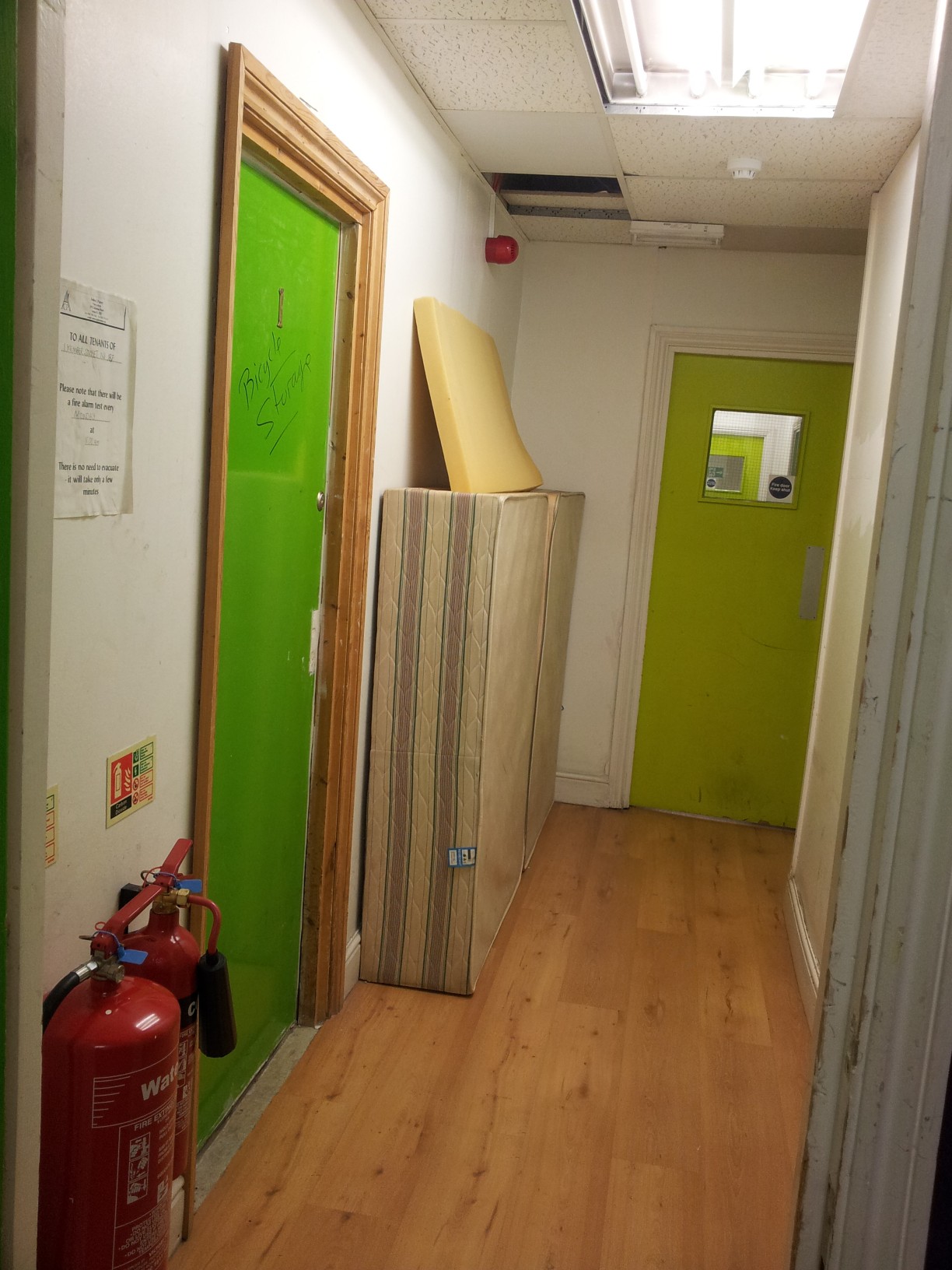
Mattresses stored in a hallway posing fire hazard and escape route obstacle.
Islington Council immediately sent-in an inspection team to check if it met housing condition rules and to investigate a probable breach in planning permission. The Council inspectors have found that Kember Street contains other, similar, sized rooms. Prohibition notices have been served and a planning enforcement case opened. Fire Brigade investigators will also be checking for breaches in safety rules.
Local Councillors have been going after Mr Panayi for over 3 years. He shot to fame almost 2 years ago after boasting on a TV programme that he “built first, ask for permission later”. The TV documentary can be seen online in two separate sections: click here for part 1 and here for part 2.
At a very large and very angry meeting in July 2012, around 200 local residents took the Council to task for letting him get away with planning infringements on a colossal scale. At that meeting, elected Councillors and senior officials pledged that Islington Council would bring thorough enforcement action.
The Council hired extra enforcement officers and in Autumn 2012 began extensive investigations into Mr Panayi’s properties which uncovered dozens of unuathorised developments. But many of his unpermitted flats and bedsits had been converted more than 4 years prior to investigation. A bizarre loophole in planning law has meant that many of these substandard and unpermitted developments were therefore deemed legal.
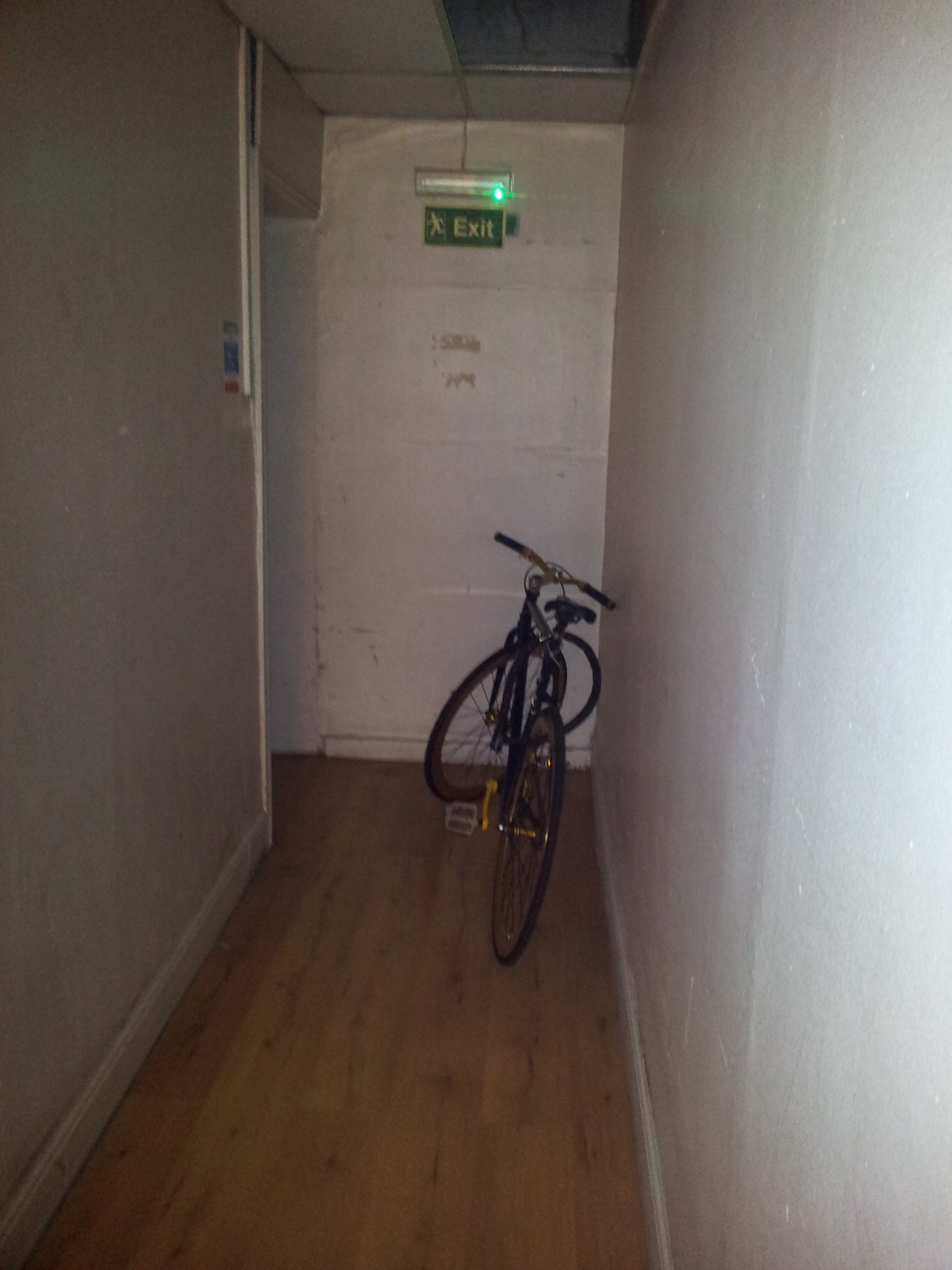
A bicycle left in a hallway obstructing the fire exit door.
When the pictures of the 1 Kember Street room became public, Islington Council moved swiftly to inspect the premises and immediately issued a prohibition order against using the room (and others like it) for residential purposes. The building consists of up to 40 rooms of differing sizes all of which are now being inspected by the Council.
Despite Mr Panayi’s assertion that he has planning permission, it seems clear that he has made significant changes to what was originally student hostel-type accodomadation. Previously there had been a number of small study bedrooms served by communal kitchen areas down a hallway. Instead Mr Panayi has installed kitchen units into bedrooms thereby making them self-contained.
It is very likely these changes were made relatively recently. In February 2011 Mr Panayi submitted drawings of the ‘existing’ internal layout when he submitted a planning application to add a further 2 storeys to the building. He was refuse. But those drawings demonstrate the building was inits student hostel arrangement at that time. Those drawings can be seen here: (first floor and mezzanine) and (second floor).
The rooms are arranged over the 1st and 2nd floors of the building which has the Co-op supermarket at ground floor level. In a further extraordinary admission, Mr Panayi has owned-up to a communal roof terrace for the building which also does not have planning permission.
Local Councillors have requested that the fire brigade re-inspects the premises after photographs emerged which showed hazards in hallways that could might impede emergency exits.
Cally Councillor Paul Convery comments “It is incredible that this landlord continues to charge extortionate rents for sub-standard accomodation in buildings where he does not have full planning permission. Despite being previously caught-out on a huge scale, Mr Panayi keeps flouting a regulatory system which is designed to ensure minimum standards of living accomodation, safety and amenity in our neighbourhood. The breaches of planning control and housing standards at Kember Street are absolutely shocking. Mr Panayi has wriggled through a legal loophole in the past. But this case will finally nail him.”
Related links to the actions of this landlord, and the Council’s response, are at:
Enforcement action underway against multiple bedsits and over crammed flats on Caledonian Road (June 2012)
Council steps up enforcement action against build first, ask later Cally landlord (July 2012)
Enforcement blitz against planning and licensing breaches on the Cally (November 2012)

Pictured immediately after the result was declared, Rupert, Una and Paul with Emily Thornberry MP
Labour’s candidates Paul Convery, Una O’Halloran and Rupert Perry were elected to represent Caledonian Ward on polling day, 22nd May. They join 44 other Labour Councillors elected in a dramatic landslide for Labour throughout Islington.
The new Council will have 47 Labour Councillors and 1 Green following the defeat of every single Lib Dem. Borough-wide, this election was Labour’s best result since 1974.
In Caledonian Ward, the Labour team received 61% of the vote. The votes were: Paul Convery (2,327), Rupert Perry (1,954) and Una O’Halloran (1,907). The next nearest candidate was 1,237 votes behind Una.
Labour’s candidates expressed their thanks and sincere gratitude to the Caledonian ward voters who backed the Labour team so emphatically.
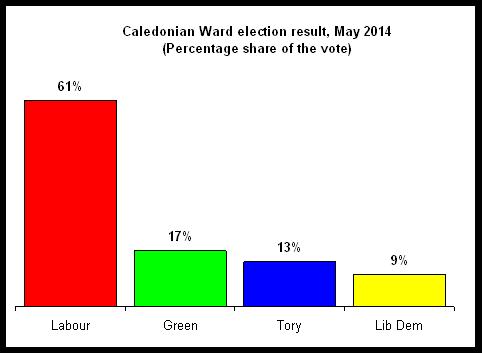 Paul Convery adds “The voters agree that Labour has run our Council well in the past 4, very difficult years and we’ve stood-up for the neighbourhoods we represent. We have promised to deliver genuinely affordable homes, cut crime, help people into work and provide a shield against the worst effects of a Tory Government’s austerity drive.
“We are also very grateful to the many community activists who backed us in our election and, of course, the team of Labour Party members locally especially Matthew Honeyman, Sue Cartwright, Richard Truscott and Sara Hyde. They and many others helped us speak to nearly 3,000 people between January and polling day.”
The full result published by the Islington returning officer is here.

